On this page
Quick answer
Which missed-call text-back tool should a small business choose?
Choose Quo when you want a business phone system with configurable missed-call auto-replies and do not need a full CRM. Its annual Starter plan is currently $15 per user/month ($19 monthly), with one number per user. Quo documents separate auto-replies for missed calls with or without voicemail during and after business hours, and limits the same contact to one auto-reply every three hours.
Choose HighLevel when the missed call should trigger a wider sales workflow. Its native feature can send an SMS for every missed call, and HighLevel explicitly warns that repeat callers can receive multiple messages unless you add workflow filters/waits. Choose Jobber when you already run a home-service operation there: its Receptionist can answer calls/texts, book jobs, and send SMS back when a caller disconnects before the conversation starts.
Grasshopper is the simpler flat-rate phone alternative; Podium is much broader and costlier; Weave is worth considering when the phone/text workflow is part of a practice communication system.
Workflow
What missed-call recovery should actually do
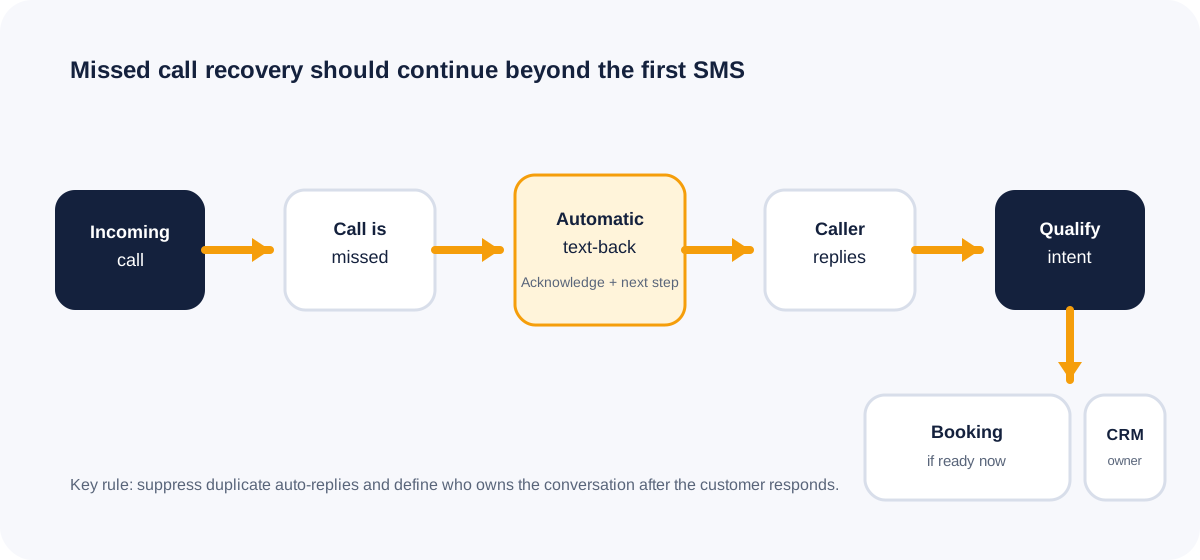
A missed-call text is only the first acknowledgement. The operational value comes from what happens after the caller replies: can your team see the thread, can the system avoid repeated autoresponses, can a qualified lead book, and does someone own the follow-up?
Methodology
How we compared the tools
- TriggerDoes the product explicitly document automatic SMS after a missed/unanswered call?
- ConversationCan the caller reply and continue in the same business inbox?
- Repeat caller behaviorDoes the vendor suppress duplicates or require you to build filters?
- Next stepCan the workflow route, book, qualify or create CRM ownership?
- Cost realityBase plan, add-ons, usage limits and registration requirements.
- CheckedOctober 21, 2026
Comparison
Missed-call text-back software compared by situation
| Tool | Best fit | Text-back behavior | Current cost signal | Main trade-off |
|---|---|---|---|---|
| Quo | Small teams wanting a real business phone + simple auto-replies | Separate missed-call/voicemail rules; one auto-reply per caller every 3 hours | Starter $15/user/mo annual; $19 monthly; messaging registration fees apply in US | Basic auto-reply still needs a human unless you add Sona/automation |
| Grasshopper | Solo/small business wanting a flat-rate virtual phone | Instant Response texts new callers when you cannot pick up | Plans currently start around $14/mo annual | Designed as acknowledgement, not a deep lead workflow |
| HighLevel | CRM + pipeline + automation | Native missed-call text-back; every missed call can trigger unless filtered | Core agency plans $97/$297/$497 + phone/SMS usage | More setup and platform complexity than a basic phone app |
| Jobber | Home-service operators already running jobs in Jobber | Receptionist can send SMS back when caller disconnects before conversation | $29/mo add-on on select plans: 30 conversations, then $0.79 each; included on Plus with unlimited usage | Broader AI/FSM purchase, not a standalone autoresponder |
| Podium | Local businesses wanting phones + messaging + reviews + AI follow-up | Missed caller gets a text; AI Employee can continue conversation | Core is currently cited by Podium from $399/mo; higher plans/add-ons increase cost | Large platform and price if text-back is your only need |
| Weave | Practices using phone trees/call queues and patient/customer texting | Missed-call text can move callers from queue/phone tree into a text thread | Quote-based; feature availability depends on bundle | Less transparent pricing; strongest fit is practice communications |
1. Quo (formerly OpenPhone)
Why it stands out: Quo is one of the clearest implementations of actual missed-call auto-reply rather than a generic automation workaround. Its documentation gives separate triggers for missed calls with voicemail, missed calls without voicemail, incoming texts, and business-hours/after-hours behavior.
The repeat-caller rule is especially useful: Quo says it sends only one auto-reply every three hours to the same contact. That prevents a caller who tries five times in an hour from receiving five copies of the same “sorry we missed you” message.
Quo currently lists Starter at $15/user/month annually or $19 monthly, with one number per user and US/Canada calling and messaging subject to its fair-use policy. For US texting, its pricing page lists a $19.50 one-time carrier review/setup fee plus roughly $1.50–$3/month messaging fee. That is exactly the kind of small recurring cost buyers miss when they compare only the sticker price.
Choose Quo when
You need a clean business number, shared calling/texting and predictable missed-call acknowledgement—but you do not want to operate an agency CRM just to send the first SMS.
2. Grasshopper
Grasshopper calls its feature Instant Response: when you miss a call from a new caller, the system can automatically text them, and they can reply with details or arrange another time. That makes it a good fit for solo operators who mostly need acknowledgement rather than lead scoring or multi-step nurture.
Grasshopper's current site says plans start around $14/month on annual billing, with options designed around numbers/extensions rather than the per-seat structure common in other VoIP tools. That can be attractive if several people need access to one number.
Choose Grasshopper when
You want the phone system itself to be simple, the team does not need a complex CRM workflow, and a standard automatic reply is enough to buy time until a person responds.
3. HighLevel
HighLevel's native Missed Call Text Back feature automatically sends SMS after an unanswered inbound call. In September 2026 it also documented smarter sending-number selection: if the number the caller dialed cannot send SMS, HighLevel can fall back to another eligible messaging number in the location.
The key operational warning is repeat callers. HighLevel says the feature triggers an SMS for every missed call, even when the same person calls repeatedly in a short window. The vendor recommends moving the logic into a workflow with waits, tags or filters when you need suppression.
HighLevel's core subscription plans are currently $97, $297 and $497/month, and phone/SMS usage is billed separately. This is rarely the cheapest way to solve one missed-call problem. It becomes attractive when you also want CRM records, pipelines, booking, nurture sequences and multi-channel follow-up.
Choose HighLevel when
The missed call should become a contact, enter a pipeline, trigger follow-up and potentially book—rather than simply receiving one acknowledgement text.
4. Jobber Receptionist
Jobber sits one level above simple text-back. Its AI Receptionist can provide 24/7 service over call or text, answer questions and book jobs. Its SMS send-back feature specifically covers callers who hang up before Receptionist starts a conversation.
Jobber also publishes unusually clear usage rules. Receptionist is currently a $29/month add-on on select plans with 30 conversations included; overage is $0.79 per additional conversation. It is included on Plus with unlimited usage. For SMS send-back, Jobber says callers do not receive another text-back if they received one in the previous 24 hours, which is a useful anti-spam guardrail.
Choose Jobber when
You already manage quotes, jobs and appointments in Jobber and want phone recovery to end in the same operational system—not in a separate inbox your technicians ignore.
5. Podium Phones
Podium's current phone product explicitly says a missed caller receives a text and its AI Employee can keep the conversation going. The same platform also combines calls/texts, web chat, reviews, payments and other local-business messaging.
That breadth is both the attraction and the trade-off. Podium's own current content cites Core from $399/month and Pro from $599/month, with AI Employee available as an add-on. If the only hole in your process is “send one text when I miss a call,” that is hard to justify. If you already need reputation management and a consolidated local-business inbox, the economics can look different.
Choose Podium when
Your phone lead is only one channel in a larger local-business communication and reputation stack, and you want AI to continue the conversation after the missed call.
6. Weave
Weave documents a Missed Call text that can move callers out of a phone tree or call queue into a text conversation. That is a different buyer from the solo contractor looking for a $15 autoresponder: Weave is designed around practice communication workflows, and feature access depends on the selected bundle.
Because Weave does not publish simple public self-serve pricing for this feature, treat it as a demo/quote comparison rather than trying to force it into a clean monthly-price ranking.
Choose Weave when
You are evaluating a broader practice phone/text system and want callers to escape a queue into messaging—not when you only need a standalone missed-call autoresponder.
Before you buy
The costs and rules that change the decision
1. Carrier registration is not optional for US business texting
Tools may expose the fee differently, but US local business texting commonly requires carrier registration. Quo explicitly lists registration/setup and monthly messaging fees. HighLevel notes A2P/toll-free verification requirements and says messages still count toward phone messaging usage.
2. Repeat callers can expose bad automation
Quo suppresses duplicate auto-replies to the same caller for three hours. Jobber's SMS send-back uses a 24-hour window. HighLevel's native feature can fire on every missed call unless you design workflow filters. This small detail matters because a panicked customer may call repeatedly.
3. “Text-back” and “AI receptionist” are not the same category
Text-back reacts after an unanswered call. An AI receptionist attempts to answer or receive the forwarded call, hold a voice conversation, capture information and sometimes book. Some products now offer both, which is convenient but can make pricing comparisons misleading.
Read our missed-call text-back vs AI receptionist guide before paying for voice AI if a simple SMS could solve your actual problem.
Message design
A better first text is short and action-oriented
Do not turn the autoresponse into a marketing campaign. A useful message acknowledges the miss, identifies the business, gives the caller a low-friction way to continue, and avoids promises your team cannot keep.
Example: “Hi — this is Riverstone Plumbing. Sorry we missed your call. You can reply here with the service you need and your postcode, or book an estimate here: [link].”
If your system supports STOP/opt-out handling, business-hour rules and consent controls, configure those before sending live traffic. The exact compliance requirements depend on your location, number type and messaging program.
Verification
Primary sources checked
- Quo: respond to missed calls by textAuto-reply triggers, business-hour rules and three-hour repeat suppression.
- Quo pricingPlan pricing, carrier registration and messaging fees, Sona credits.
- Grasshopper Instant ResponseAutomatic text response to missed/new callers.
- Grasshopper pricingCurrent plan structure and annual pricing.
- HighLevel Missed Call Text BackTrigger behavior, repeat callers, sending-number fallback and messaging usage.
- HighLevel pricing guideCore plan tiers plus phone and AI usage context.
- Jobber Receptionist helpSMS send-back, 24-hour suppression, included conversations and overages.
- Jobber pricingReceptionist add-on pricing and plan context.
- Podium PhonesMissed-caller text and AI Employee continuation.
- Podium platform pricing referenceCurrent Podium-published Core and Pro price references.
- Weave missed-call textPhone tree/call queue conversion into text conversations.